
Financial Management in Uncertain Times with Onventis CFO Tilo Schmalz
Financial management is no longer merely an administrative discipline. Digitalization, artificial intelligence, and a growing body of European regulations now shape the work of CFOs and financial managers. Additionally, the current geopolitical situation forces companies to scrutinize their technology partners more critically than ever.
Onventis deliberately positions itself as a European source-to-pay software provider. In this interview, Tilo Schmalz, CFO at Onventis, discusses the market situation, the challenges facing companies, and why digital sovereignty is primarily a financial issue.
In your role as CFO, what is your assessment of the current market situation?
Tilo Schmalz: The European market for digital procurement and invoice processing solutions remains in a state of flux. At the same time, it is a challenging phase. The economic outlook is mixed: inflation, supply chain disruptions, and political uncertainty are leading companies to manage costs and risks more closely than ever.
As CFO, I also see a clear shift in the conversations we’re having. Companies want to know who they’re doing business with and where their critical business processes end up. We have a clear answer to precisely these questions.
What challenges do you see for European companies concerning financial management?
Schmalz: The problems are strikingly similar, regardless of industry or company size. The biggest challenge is fragmentation. Many companies still rely on a mix of email inboxes, Excel files, ERP systems, and specialized individual solutions. This makes it virtually impossible to achieve real-time transparency.
The second issue is compliance. With initiatives like CSRD, stricter VAT rules, and e-invoicing requirements, finance teams must report significantly more than before. However, their core processes are not designed for this. When contract data, procurement data, and invoices are scattered across different systems, accurate reporting becomes an enormous task.
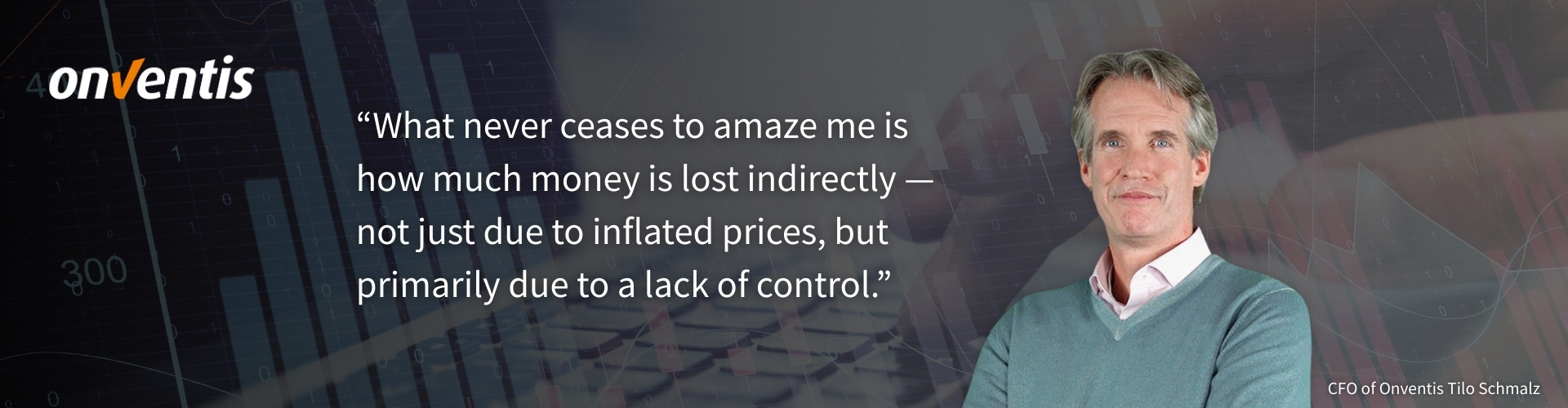
Furthermore, many processes have evolved over time. What never ceases to amaze me is how much money is lost indirectly—not just due to inflated prices, but primarily due to a lack of control. Contractual obligations are not actively monitored; supplier agreements lack transparency, and expenses only become visible after the money has already been spent.
Organizations are increasingly realizing that this needs to change. The challenge, however, is: how do you tackle this in a structured way without immediately launching a massive project? At Onventis, we aim to support this in a very pragmatic way, with a modular platform that you can implement step by step.
You mentioned that companies are paying closer attention to what happens with their critical, what does digital sovereignty mean in this context?
Schmalz: For us, digital sovereignty means that technology, data, and core processes operate within a clear and predictable legal framework. We develop our platform in Europe and ensure that our solutions comply with European laws and regulations.
The relevance of this issue has grown in recent years. Companies want transparency regarding where their data is stored and which legal regulations apply.
The current geopolitical dynamics are simply heightening awareness of dependencies in digital infrastructure. More organizations are therefore consciously asking themselves: How do we combine innovation and user-friendliness with legal clarity and strategic autonomy? We offer a fully European alternative that is technologically competitive but based on transparency and stability.
AP automation is one of Onventis’ key areas of focus. How do you view the role of AI in financial management?
Schmalz: For me, AI is primarily a tool for reorienting the finance department toward a strategic focus. Too many teams are currently bogged down in repetitive tasks: entering data, tracking invoices, and generating reports. That’s a waste of talent.
Intelligent automation can reclaim this time. Touchless invoicing is a good example of this. When the majority of invoices are automatically recognized, reconciled, and correctly posted, not only are processing times shortened, but the costs per invoice also decrease significantly.
The real added value, however, lies in quality. AI can detect patterns that humans overlook, such as deviating price trends, duplicate invoices, or suppliers who are not operating in accordance with contracts. In this way, technology becomes an active controller rather than a passive archive.
The introduction of AI agents within our platform follows precisely this approach. They assist users, for example, in uploading and interpreting quotes in PDF format, structuring intake processes, and creating contracts more quickly.
Ideally, this optimization shouldn’t begin only when the invoice is received. If you truly want to achieve efficiency, you must design and optimize processes correctly from the very start. The greatest gains are found at the beginning of the process, during the requisition and approval of products or services. When budgets, legal entities, cost centers, general ledger accounts, and item groups are recorded correctly from the start, the final invoice becomes a logical and predictable outcome of the process rather than an unpleasant surprise.
For organizations, this means gaining more control in less time. And control is ultimately what financial management is all about: transparency, predictability, and manageability.
Finally: What would be your most important piece of advice for the readers of this interview?
Schmalz: My advice is to stop viewing technology decisions as merely operational projects and instead see them as strategic investments. The way your procurement and invoicing processes are structured has a direct impact on financial performance.
In doing so, you should look beyond mere cost savings. These are important, but without good data management and transparency, savings are often only temporary. Sustainable value is created when processes are efficient, compliant, and secure.
I also recommend strengthening collaboration between the CFO and the CPO. Purchasing is one of the largest cost drivers in a company. When the finance and procurement departments work with the same data, they can manage suppliers, contracts, and ESG goals much more proactively.
And last but not least: Ask your software partners critical questions. Where is my data stored? How future-proof is this platform? Can it adapt to evolving regulatory requirements?